

Some FHIR imports are safe to run directly against production. Most are not. Deciding which category you are in — and standing up a staging environment when you need one — is a small planning discipline that prevents a specific class of incident: the "we just corrupted every Patient record in production" call at 3 AM. The site's Bulk import time estimator can also run against your staging environment to inform the production run. For the wider FHIR framing, more on FHIR for outpatient settings has more.
When Production-Direct Is Fine
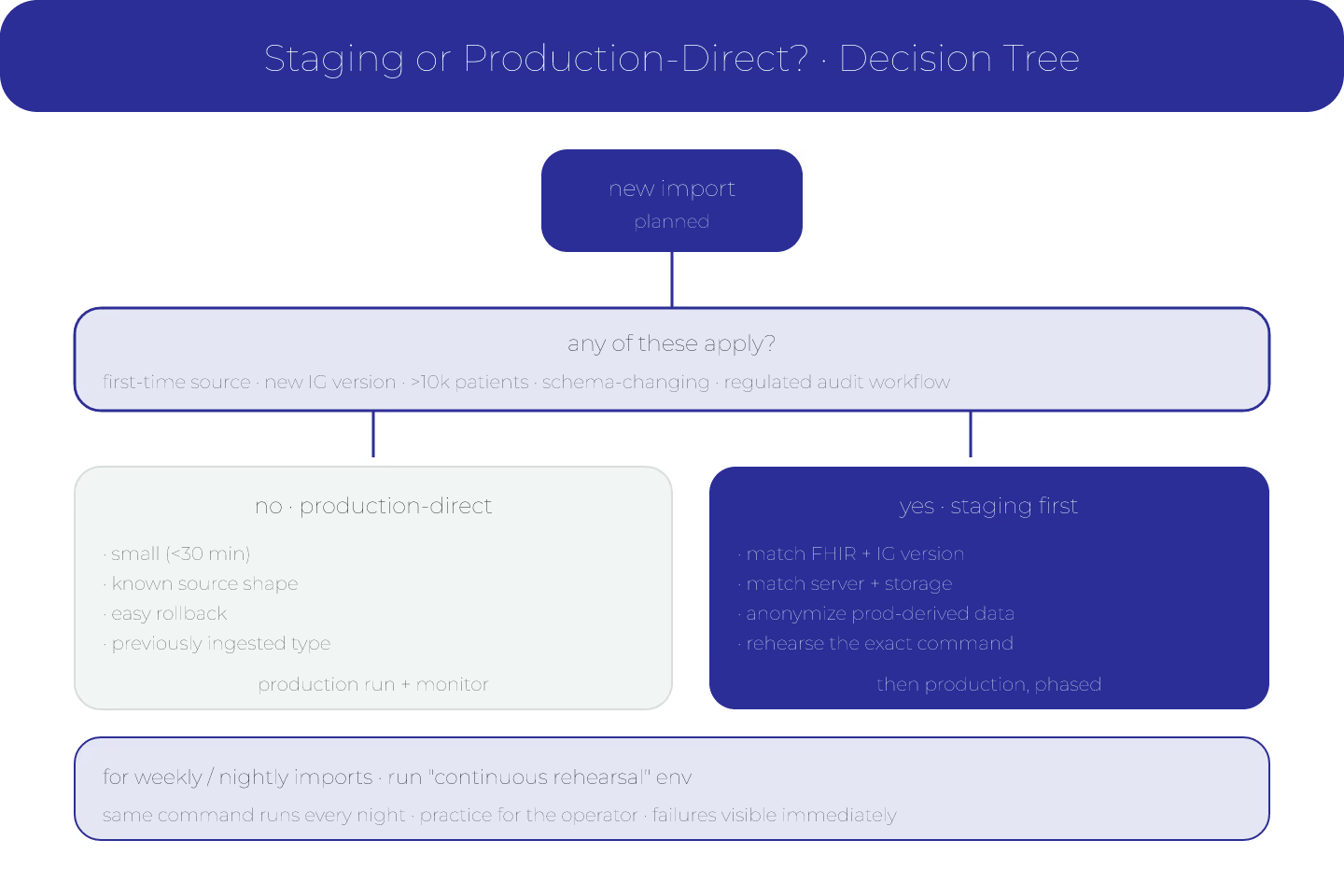
- The import is small (under 30 minutes)
- The data is well-understood and previously ingested
- The target server has a known throughput baseline
- Rollback is trivial (transactional bulk delete)
Small, well-understood, easily-reversible imports do not need staging.
When You Absolutely Need Staging
- First-time import from a new source (unknown data shape)
- New profile or IG version (unknown validation behavior)
- Very large import (rollback is expensive)
- Import that changes schema (e.g., new extension slots)
- Any regulated workflow with audit implications
Every one of these deserves a staging pass. Skipping the pass buys risk you cannot easily quantify.
For the recovery side, recovering from a failed import without starting over is the entry.
What Staging Should Match
- FHIR version — same major/minor as production
- Server implementation — same vendor and version
- Storage — same backend and configuration
- Terminology — same value sets loaded
- Profiles — same IG version bindings
Staging that does not match production produces false confidence. Investing in a matched staging environment is cheaper than debugging in production.
What Staging Can Skip
- Full data volume — a slice is often enough to catch shape issues
- Real user auth — service accounts work for import testing
- Full observability — enough to verify success, not full production dashboards
Staging is for testing, not for scale. Test at scale in production with a phased rollout.
For the traffic-window side, planning an import around production traffic windows is the entry.
The Rehearsal Rule
Every non-trivial import should be rehearsed on staging at least once:
- Same command as production
- Same data slice
- Same operator running the command
- Same verification steps
Skipping the rehearsal produces the "operator got the flag wrong" surprise.
The Data Refresh Cadence
Staging data goes stale. Regular refreshes:
- Weekly for active development environments
- Monthly for pre-production
- Ad-hoc before major imports
Stale staging misses the exact issues the refresh would catch.
The Anonymization Question
Production data in staging needs anonymization for privacy:
- Names and addresses replaced
- Dates shifted consistently
- Identifiers rewritten
- Free-text scrubbed
Do not skip anonymization for expediency. The audit finds you eventually.
The Cost-Benefit
Staging costs money. Rules of thumb:
- Under 100 patients — staging is optional
- 100-10000 patients — staging pays for itself in avoided incidents
- 10000+ patients — staging is mandatory
Compare to the cost of a production incident. Staging usually wins.
The Repeatable-Import Pattern
If you import routinely (weekly ETL, nightly sync), stand up an environment that runs the same import every night:
- Same command, same source
- Immediate visibility to failures
- Practice run for the operator every night
That is not staging; that is a continuous rehearsal. For the design side, designing a repeatable import that survives schema changes is the entry.
The Short Version
Small imports: production-direct. First-time, large, regulated, or schema-changing imports: staging. Match staging to production carefully. Rehearse the same command an operator will run. Refresh data. Anonymize. Continuous rehearsal beats occasional staging for routine imports.
Sources
- HTML - HTML, HL7 FHIR - Conformance Module overview (CapabilityStatement, testing)
